How to Prepare for a Podcast Interview: A Guest Checklist for Experts
To prepare for a podcast interview as a guest, confirm the audience and format, choose a useful question you can answer, and gather the evidence and examples behind that answer. Agree on sensitive topics and recording expectations with the host, then test your setup. Use a short preparation brief so you can explain your expertise clearly while leaving room for a real conversation.
Prepare for the listener's decision
A founder can know a subject deeply and still give an interview that leaves the audience unsure what to do with it. Preparation connects your experience to a question the listener recognizes. The aim is to make your judgment understandable, rather than to fit your entire biography into the conversation.
Start with the booked appearance. This guide is for the expert answering questions, whether on someone else's show or in a strategic interview for their own business. It is not a checklist for launching a podcast, pitching yourself as a guest or editing the recording afterward.
In AMN's language, the Authority Gap is the distance between earned expertise and market recognition. A clear interview can help make that expertise visible. It still needs a relevant audience and sound supporting evidence; recording more minutes alone does not establish authority.
1. Confirm the audience, format and purpose
Ask the host who the episode is intended to help and what they want listeners to understand. Listen to a recent episode to hear the level of detail, the pace and the host's approach to follow-up questions. Decide which parts of your experience are relevant to that particular audience.
Confirm the practical details before setting aside the time: the date and time zone, arrival time, recording length, remote or studio location, and whether the conversation is live or recorded. Ask whether video, a demonstration or a screen share is involved. A video interview needs preparation that an audio-only conversation does not.
Georgetown University Library's media guidance recommends clarifying the subject, audience and format, gathering supporting facts, and rehearsing explanations in plain language. For a business podcast, turn that groundwork into a specific listener question you and the host both recognize.
Confirm with the producer
- The intended listener and the main question for this episode.
- The time zone, arrival time, format and expected duration.
- The recording platform or studio address and any equipment instructions.
- Whether the episode is live, edited, audio-only or video.
- The process for flagging factual corrections and discussing reuse of the recording.
2. Choose an answer you can support
Write down a question you hear from the people your business serves. Then write the answer in one direct sentence. If that sentence needs several qualifications before it means anything, narrow the question. A focused explanation gives the host something concrete to explore.
For example, a hypothetical brand strategist might begin with: ‘Does our homepage need new visuals or a clearer explanation of the service?’ They could suggest asking a person in the intended audience to explain who the page helps, what problem it addresses and what to do next. This gives the conversation a specific question to investigate before discussing a redesign.
That is more useful than a broad promise to help businesses scale. It gives the listener a decision to investigate. It also leaves room for a host to ask when the approach would fail, what a practical first step looks like, or how the consultant reached that conclusion.
3. Build an answer, evidence and boundary brief
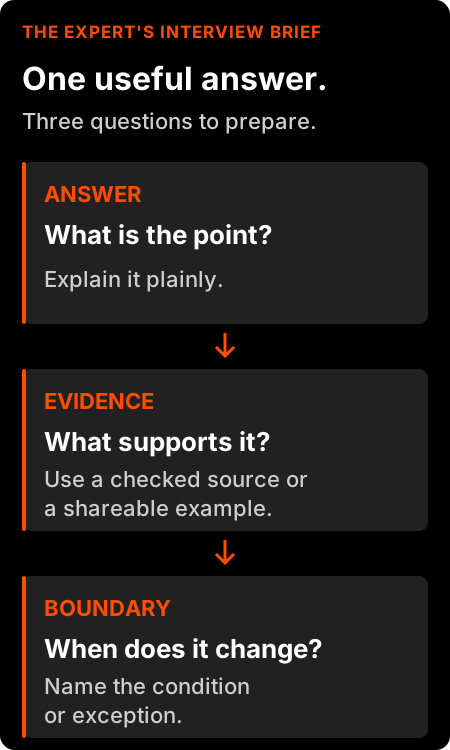
Keep a compact working brief beside your notes. For each idea you want to discuss, record the answer, the evidence that supports it and the boundary that keeps it accurate. This is an editorial preparation tool: it helps you explain what you know without implying that one example proves a universal rule.
Evidence might be a checked source, a documented process, a demonstration or an experience you are authorized to describe. If you use a numerical result, verify the period, population and meaning of the measure. If those details are missing, remove the number or explain what you can establish instead.
Use the boundary to note what the example cannot show. A process that helped one team is not proof that every organization should adopt it. Say whether you are describing your own experience, reporting a research finding or offering an interpretation. Share relevant sources with the host when they will help the conversation or show notes.
The point in plain language
One direct explanation of the listener's question. Start with the decision, then expand when the host asks.
The reason to believe it
A verified source or a specific, shareable example. Keep enough context to explain what it does and does not demonstrate.
The limit that matters
The condition, uncertainty or exception that would change your answer. Make it part of the explanation.
A worked example: make the explanation usable
Return to the hypothetical brand strategist. A weak preparation note says: ‘Talk about branding and design.’ It names a subject but gives the listener no useful way to examine their own homepage.
A stronger answer brief says: ‘Before commissioning new homepage visuals, check whether an intended reader can explain the service from the existing page.’ The strategist could show a fictional page and demonstrate the questions they would ask. That demonstrates a process; it is not evidence that this test or a redesign increases sales. Any claim about business results would need separate supporting data.
In the interview, the strategist can explain what they would listen for in the reader's response and what they would need to investigate next. They can also state the boundary: understanding a page is only one part of evaluating it, and a single person's response does not represent the whole market. This is an illustrative example, not an AMN client case study or a validated research method.
4. Resolve sensitive material before the conversation
Identify names, client details, unreleased work, internal numbers and topics you cannot discuss. Replace a sensitive example with an approved alternative before recording day. An anonymous story can still identify someone through its details, so check the actual example rather than assuming a removed name settles the issue.
Explain the boundaries to the host. If you need to check a fact during the interview, say so and offer to follow up. An honest limit gives the host a chance to clarify the question or move to an area where you can contribute.
Ask what the show's editing and correction process allows. Do not assume you will approve the final episode, receive the raw files or have permission to publish clips. Confirm the expectations directly. For a live appearance, plan to give only examples and claims you are already comfortable making publicly.
5. Test the setup you will actually use
Follow the producer's current instructions and test with the same device, room and microphone you will use for the interview. Record a short sample at your normal speaking volume and listen back. Ask the producer to help resolve echo, background noise or a microphone selection problem before the substantive conversation starts.
For a remote session, choose a quiet space, use headphones and check the selected input and output devices. Riverside's guest checklist recommends headphones to prevent echo, checking the connection and microphone, and lighting your face from the front for video. Other platforms have their own requirements, so verify the instructions for the actual invitation rather than treating every recording link as identical.
If the interview is in a studio, ask what the team provides, when to arrive and what you need to bring. If your explanation depends on a prop or demonstration, arrange it in advance. A technical check should support the conversation, not become a last-minute search for an unfamiliar setting.
6. Rehearse the explanation, then leave room to listen
Ask a colleague to pose the listener question without showing them your notes. Give the direct answer, explain one example and state the condition that matters. Then ask what they understood. If they repeat a different claim or miss the point, revise the explanation before adding more material.
Use prompts rather than a paragraph you intend to read word for word. In a conversation, the host may need a definition, a contrasting example or a different starting point. Keep listening so your response answers the question that was actually asked.
Prepare one relevant resource or next step in case the host invites it. Give the listener something that fits the discussion and confirm the destination works. You do not need to turn every answer into a pitch. Let the usefulness and accuracy of your explanation carry the expertise.
Your recording-day checklist
Use the brief to settle the essentials before you join. During the conversation, flag uncertainty and correct a mistaken fact rather than allowing it to become part of the story. Afterward, send any sources or corrections you promised through the producer's agreed process.
Stay connected until the producer confirms the session is finished. Riverside specifically instructs guests to leave the browser tab or app open until the recording upload completes. Once the host shares the approved episode and reuse expectations, you can decide which parts deserve a useful article, clip or follow-up resource.
Ready for the conversation?
- I know the audience, format, time zone and arrival details.
- I can answer the main question directly and explain a relevant example.
- I have checked important facts and marked the limits of each claim.
- The host knows the topics and details I cannot discuss.
- I have tested the actual room, microphone, headphones and video setup.
- My notes are prompts, and I have a working link if the host asks for a resource.
- I know how to flag corrections and when it is safe to leave the recording session.
Turn expertise into a clearer authority plan
If your business has earned expertise but no clear plan for making it visible, apply for a complimentary Authority Assessment. We review for fit before scheduling and help identify the priorities your Authority Blueprint should address.