How to Measure Brand Authority: 7 Signs Your Expertise Is Getting Recognized
Measure brand authority with seven signals: branded searches, relevant mentions, invitations, qualified referrals, content-informed inquiries, ongoing audience engagement, and confidence in sales conversations. Track them over consistent periods to see whether the right people recognize, trust, and seek out your expertise. No single score tells the whole story.
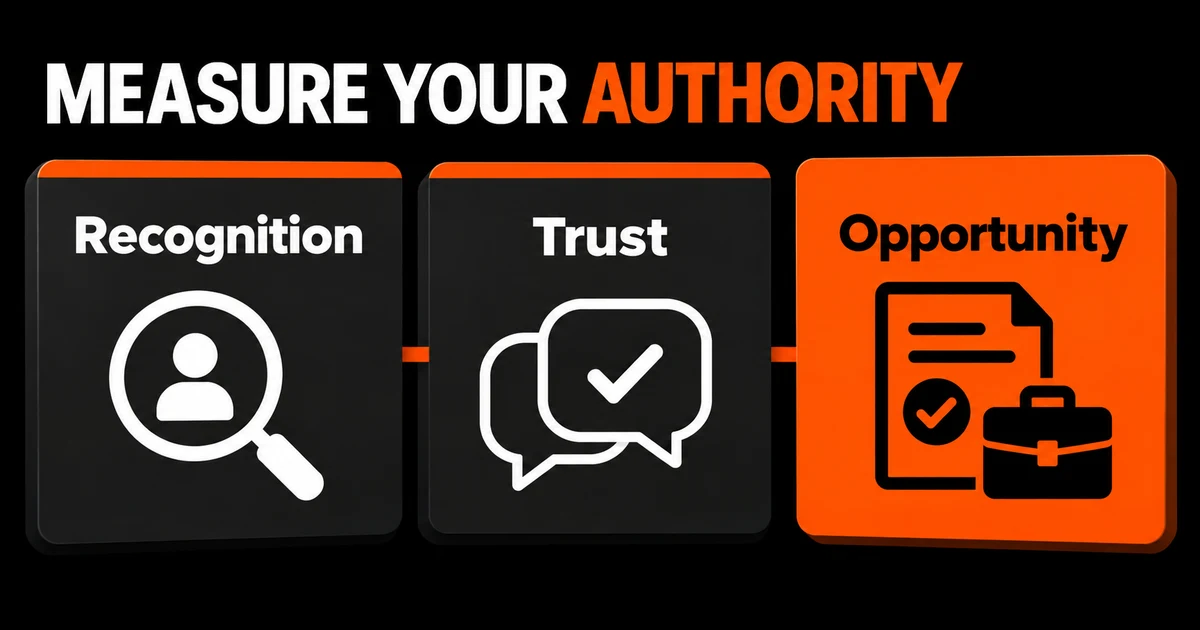
Start with recognition, trust, and opportunity
You can be excellent at what you do and still be overlooked. Authority Media Network calls that distance between earned expertise and market recognition the Authority Gap. Measuring it starts with a practical question: are the people you want to reach beginning to recognize what you know and act on it?
For this guide, brand authority means being recognized and trusted for a specific area of expertise. It is broader than visibility. A popular post can attract attention without helping a potential client understand why you are qualified to solve their problem.
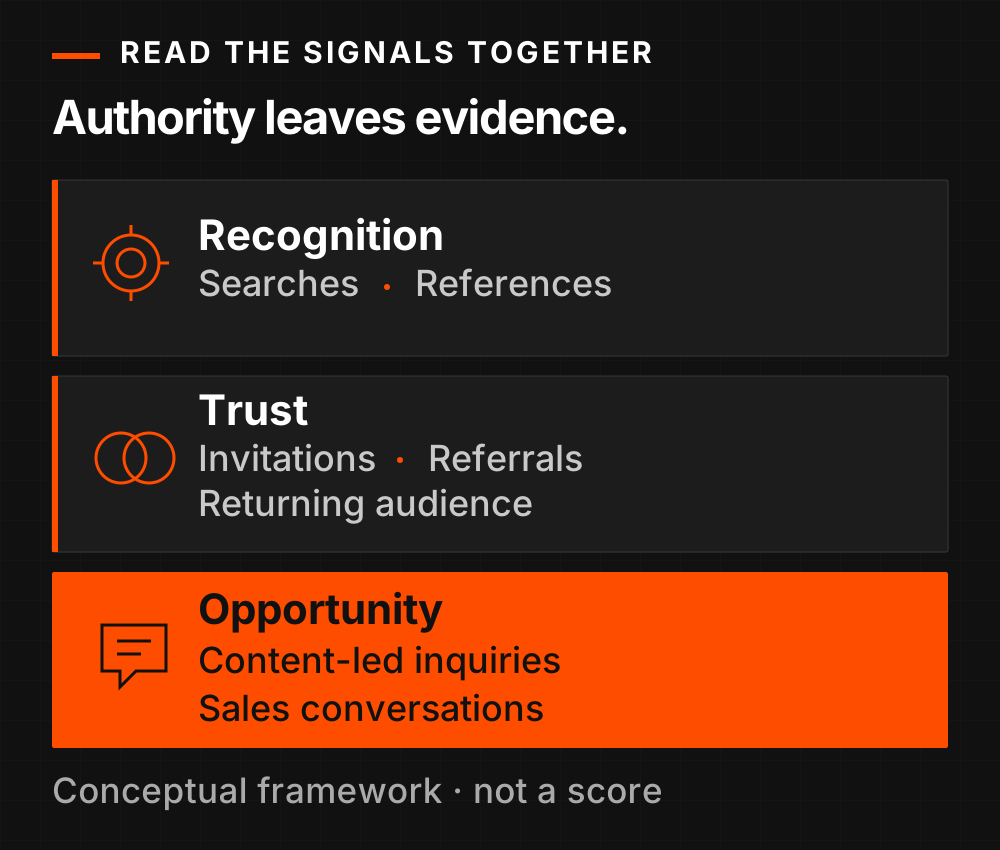
Use the seven signals below as a working framework, not a validated scoring model or a universal industry benchmark. The first signals show recognition; the later ones help you investigate whether that recognition is contributing to business opportunities. Read them together.
This is also different from an SEO tool's domain-strength metric. Such a metric can inform an SEO review, but it cannot tell you whether a buyer trusts your advice or a client would recommend you. AMN's Authority Scorecard offers a separate self-assessment of authority and visibility; this guide helps you track observable activity over time.
1. People search for you by name
A person who searches for your business, your name, or a distinctive framework has some awareness of you already. Tracking those searches can help you see whether recognition is spreading beyond the audience you reach directly.
In Google Search Console, filter queries for your business name and relevant variations. Record impressions and clicks for a consistent period, such as the last complete calendar month. Review the actual queries to exclude another company with a similar name. Include a founder's name only when the search clearly relates to your business.
Compare like-for-like periods and keep the same query rules. Query filters omit anonymized searches, so the totals are an incomplete view. Search impressions reflect appearances of your site, not every search for your brand. Neither measure is a complete count of everyone who knows you.
Write down what else happened: a paid campaign, conference appearance, press feature, seasonal demand, or a change in search visibility. More branded searches are a signal to investigate, not proof that one article created more trust.
2. Relevant people reference your expertise
Look for other people citing your work, discussing your ideas, or pointing their audience to a resource you created. The important question is who is making the reference and why their audience would care.
Keep a simple mention log with the source URL, date, audience, topic, and whether it was editorial, paid, or part of a partnership. Record unique sources as well as total mentions so a syndicated article does not look like dozens of independent endorsements.
For example, a hypothetical consultant cited in a professional association's guide may have a more relevant trust signal than the same consultant listed in several unrelated directories. Evaluate context rather than treating every mention or backlink as equivalent.
- Does the source reach people who could hire, refer, or feature you?
- Does the mention explain your expertise or simply display your name?
- Is it independent recognition, or exposure you arranged or purchased?
3. You receive invitations that fit your expertise
Speaking invitations, interview requests, expert-comment requests, and relevant collaborations can show that someone associates you with a useful perspective. Count opportunities that match the field in which you want to be known.
Separate inbound requests from opportunities your team pitched. Record the organizer, audience, topic, whether participation requires payment, and what prompted the invitation. Ask the organizer how they found you when that is not clear.
A larger invitation count is not automatically progress. Review whether the audience and subject are becoming a better fit. Declining an irrelevant appearance may be a better decision than adding another logo to a media page.
4. Referrals arrive with a clear reason to trust you
A referral becomes especially informative when the introduction explains why you are suited to a particular problem. Listen for specifics: a relevant result, a helpful explanation, a distinctive process, or direct experience working with you.
Track unique referred prospects and how many meet your established fit criteria. Those criteria might include the problem you solve, the type of organization, and its readiness to act. Keep the definition consistent so changes in qualification do not masquerade as better referrals.
Save the referring person's reason in the CRM, with appropriate access controls. Distinguish client recommendations from paid referral arrangements. Both can produce business, but they tell you different things about how trust is spreading.
5. Prospects reference something you have taught
A prospect who says an article clarified their problem gives you evidence a page-view count cannot. They can describe what they learned and why it mattered enough to start a conversation.
In inquiry or discovery conversations, ask: ‘Was there anything you read, watched, or heard from us that influenced your decision to reach out?’ Record the answer in the prospect's own words and link it to the resource when possible. Keep ‘not sure’ as a valid answer.
Count unique inquiries that reference content, then review how many are qualified. A resource that attracts the right conversations may deserve more attention even when its traffic is modest. Self-reported answers are useful evidence, but memory is incomplete; do not treat them as a complete attribution model.
See how AMN combines expertise, owned media, and distribution
6. People choose to keep hearing from you
An ongoing audience gives your expertise more opportunities to be understood. Look beyond follower totals to voluntary newsletter subscriptions, substantive replies, repeat participation, and engagement with resources relevant to your services.
Choose one or two measures you can collect reliably. For a newsletter, you might track net confirmed subscriber growth alongside meaningful replies. For a recurring event, track returning attendees. Keep purchased contacts, internal activity, and automated interactions out of your evidence wherever you can identify them.
GA4's Traffic acquisition report can help you examine sessions and engagement by channel. Use it as supporting context, not a measure of trust. In particular, a rise in Direct traffic does not prove growing loyalty: Google defines it as traffic without a clear referral source, which can include missing campaign information.
7. Qualified sales conversations show prior confidence
Review whether suitable prospects arrive understanding your approach, asking informed questions, and describing a reason they considered you. This is closer to the business outcome authority is meant to support than a count of impressions alone.
Alongside conversation notes, monitor the progression of qualified opportunities: assessments booked and attended, proposals requested, and customers won. Define each stage and count actual people or opportunities rather than every analytics event. A button click is not a booked assessment.
Compare similar opportunities and allow enough time for them to reach an outcome. If you calculate a win rate, state the denominator—for example, wins divided by all closed qualified opportunities in the period—and note how many opportunities remain open. Avoid drawing a broad conclusion from one or two deals.
Changes in pricing, offer, lead source, seasonality, and sales follow-up can also affect results. Better sales outcomes can be consistent with stronger authority without proving authority caused the change. The conversation evidence helps you interpret the numbers.
Make the monthly review useful
Begin with a baseline, not a target borrowed from another business. Choose a complete month, document your definitions, and record the raw counts. Where activity is sparse, review a quarter as well so one invitation or referral does not dominate the interpretation.
Use the worksheet below to track the same signals each month. Add one example or source for every result you want to discuss, and annotate campaigns, appearances, launches, tracking changes, and other context. Missing data should stay unknown rather than becoming a zero.
Then choose one action. If visibility grows but suitable inquiries do not, investigate audience fit, offer clarity, and the next step on your site. If referrals are strong but branded discovery is weak, make existing proof easier to find and share. If people repeatedly cite one useful guide, deepen that topic rather than publishing unrelated material just to keep a schedule.
Do not add all seven signals into an invented authority percentage. Their value is diagnostic: together, they help you see where recognition is forming, where trust is visible, and what to improve next.
Your monthly authority worksheet
Record a baseline, then revisit the same signals each month. Keep the date range and definitions consistent so the comparison means something.
Open printable worksheet| Signal | What to record |
|---|---|
| Branded search | Brand-query impressions and clicks; keep the same query filter. |
| Relevant references | Unique relevant sources; distinguish editorial, paid, and partner mentions. |
| Relevant invitations | Inbound opportunities that meet your audience and topic criteria. |
| Qualified referrals | Unique referred prospects; count those meeting consistent fit criteria. |
| Content-informed inquiries | Unique prospects naming a resource; record qualification and the resource. |
| Ongoing audience | Your chosen repeat-engagement measure and net confirmed subscriber growth. |
| Sales confidence | Evidence from conversations plus progression of qualified opportunities. |
Where is your Authority Gap?
Use the Authority Scorecard to reflect on your current position, then explore how strategy, owned media, and distribution work together.